


SEND OFFER
SEND at Fox Hollies School
At Fox Hollies, we are committed to meeting the needs of all pupils with special educational needs and disabilities (SEND). Our pupils have a range of severe and complex learning needs, and we work closely with families and professionals to ensure they are fully supported to thrive, achieve, and prepare for adulthood.
📄 SEND Information Report
Our SEND Information Report explains how we identify, assess and pupils with SEND. It outlines the approaches we use, how support is coordinated, and the specialist strategies we have in place across our informal and semi-formal curriculum pathways.
This report forms part of Birmingham’s Local Offer, which sets out the support available for children and young people with SEND across the city.
🔗 Visit Birmingham’s Local Offer website
📘 Related Documents:


Our Graduated Approach
At Fox Hollies School, our graduated approach is built on strong partnerships between families, school staff and external professionals. This enables early identification of need and ensures that every young person receives timely, personalised and effective support.
Safeguarding is central to everything we do. Clear communication, consistent information sharing and confident staff practice ensure that concerns are identified quickly and responded to appropriately.
Our approach is structured, flexible and responsive. Support is regularly reviewed and adapted in line with pupils’ needs, ensuring that provision remains appropriate, effective and focused on long-term outcomes.
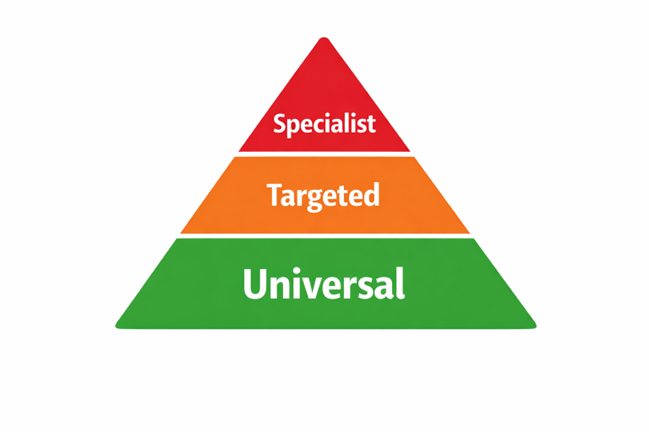
We provide support through a graduated model:
Universal provision – high-quality teaching and support for all pupils
Targeted provision – additional support for pupils who need more focused intervention
Specialist provision – highly personalised, multi-agency support for pupils with complex needs
Pupils may move between levels of support as their needs change.
-
Daily sensory regulation opportunities (e.g. sensory circuits, movement breaks)
Adapted environments informed by individual sensory profiles
Staff trained in physical support, manual handling and first aid
Whole-school awareness of medical needs and conditions
My Body, My Rights curriculum supporting health, safety and self-advocacy
-
Access to specialist equipment and targeted regulation strategies
Use of quiet rooms or low-stimulation spaces to support regulation
Input from school nurse, paediatricians or other health professionals
Individual eating, drinking and medical plans
Adapted physical activity and structured movement programmes
-
Specialist-led interventions (e.g. Occupational Therapy, Physiotherapy)
Personalised sensory and physical programmes
Specialist equipment and environmental adaptations
Support for complex medical needs
Ongoing multi-agency planning and review
-
Total Communication approach embedded across the school day
Use of Makaton, visuals, AAC, objects of reference and structured language
Visual timetables, Now/Next boards and clear transition supports
Communication-rich environments with frequent opportunities to interact
Ongoing monitoring of communication needs and development
-
Small group or individual communication interventions
Personalised communication systems (e.g. AAC, visuals, structured supports)
Targeted work on expressive, receptive and social communication skills
SCERTS-informed approaches and transactional supports
Advice, modelling and review from Speech and Language Therapy
-
Specialist Speech and Language Therapy assessment and intervention
Detailed communication profiling and planning
Use and management of high-tech AAC systems
Highly individualised communication strategies
-
Trauma-informed, relationship-based practice embedded across the school
Consistent behaviour approaches (Team Teach)
Zones of Regulation used to support emotional understanding and regulation
Predictable routines and clear structures to reduce anxiety
Strong relationships between staff and pupils
Access to family support and signposting where appropriate
-
Individual behaviour support and risk reduction plans
Behaviour data analysed to identify patterns, triggers and next steps
Targeted support to develop emotional regulation and coping strategies
Access to early help, family support and external services
Increased structure and adult support where needed
-
Intensive multi-agency involvement (e.g. Educational Psychology, FTB, social care)
Individualised support for students with complex SEMH needs
Safeguarding and child protection coordination
Support for children in need or looked after children
Enhanced pastoral and family support
-
Pathway-aligned curriculum with clear progression frameworks
Structured, differentiated teaching and adaptive practice
Use of modelling, repetition and scaffolding
Multi-sensory approaches to support understanding
Focus on independence, problem-solving and functional application
-
Targeted small group interventions and additional teaching input
Personalised curriculum adaptations linked to EHCP outcomes
Structured teaching approaches (e.g. TEACCH-informed strategies)
Precision teaching and overlearning to support retention
Adapted and accessible resources to support engagement
-
Highly individualised learning programmes
Specialist Curriculum Pathway Adjustments
Multi-agency involvement in planning and review
Use of assistive technology and specialist resources
What this means for each pupil:
Needs are identified early
Support is put in place quickly
Teaching is adapted to meet individual needs
Support increases or reduces as needs change
We work closely with families and professionals
Our aim is for every young person to feel safe, supported and able to achieve their best.
